Music & tempo
Ballroom Dance Tempos: BPM, MPM and a Reference Table
Understand ballroom dance tempos in MPM and BPM, with a sourced NDCA July 2026 reference table, conversion math, and why apps show double BPM.
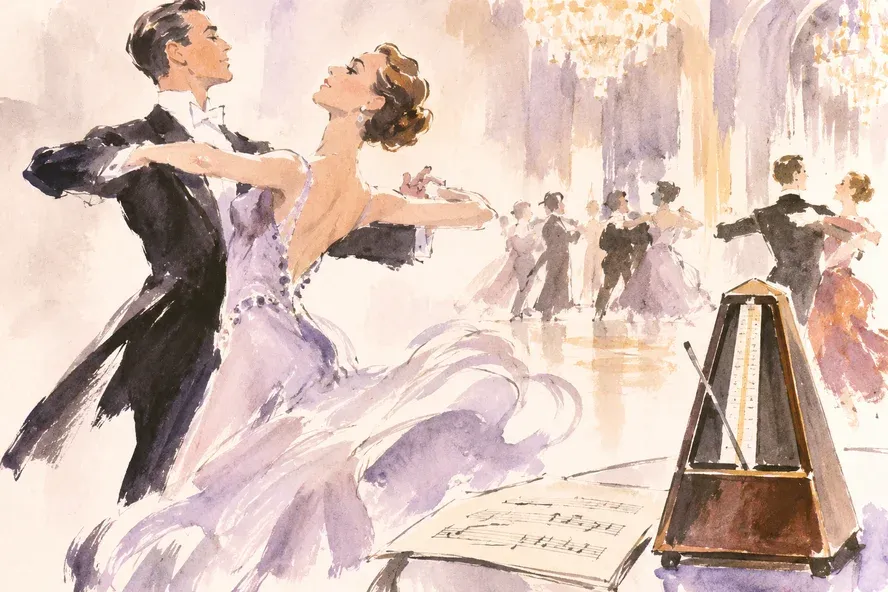
Ballroom dance tempos can be listed in measures per minute (MPM) or beats per minute (BPM). To convert MPM to BPM, multiply by the number of beats per measure. In the NDCA July 2026 competition table, International Waltz is 29 MPM (87 BPM), while American Smooth Waltz is 30 MPM (90 BPM). The style family matters as much as the dance name.
BPM and MPM measure different things
BPM counts musical beats per minute. MPM counts complete measures, also called bars, per minute. If those timing terms are unfamiliar, the ballroom dance terms glossary explains them in plain English.
The two units convert with one formula:
BPM = MPM × beats per measure
Use the beats per measure specified by your source. In the NDCA table below, Waltz and Viennese Waltz have 3, Foxtrot and Cha Cha have 4, and Tango, Samba, Paso Doble, Merengue, and Polka have 2.
A worked 3/4 example
Take International Waltz in the NDCA July 2026 rule book. The table lists 29 MPM and 3 beats per measure (3/4 time). Multiply 29 measures per minute by 3 beats per measure, and you get 87 BPM.
Now compare that with two other dances from the same rule book:
- International Foxtrot has 4 beats per measure. At 28 MPM, the math is 28 × 4 = 112 BPM.
- International Tango is listed with 2 beats per measure. At 32 MPM, the math is 32 × 2 = 64 BPM.
The MPM numbers are close together, yet their BPM values range from 64 to 112.
Ballroom dance tempos: NDCA competition table
The table below comes directly from the “Approved Tempi” section (page 40) of the NDCA Rules & Regulations, July 2026 Edition, checked on November 25, 2026. It applies to competitions sanctioned by the National Dance Council of America (NDCA) in the United States.
NDCA allows music directors to vary traditional dances by ±1 MPM and Nightclub dances by ±2 MPM at their discretion, depending on the competition’s level and needs. The separate Pro/Am and Professional & Amateur columns give identical values, so they are combined here.
| Style | Dance | Beats/measure (NDCA) | MPM | BPM | Source edition |
|---|---|---|---|---|---|
| International Ballroom | Waltz | 3 | 29 | 87 | NDCA July 2026 |
| International Ballroom | Tango | 2 | 32 | 64 | NDCA July 2026 |
| International Ballroom | Viennese Waltz | 3 | 58 | 174 | NDCA July 2026 |
| International Ballroom | Foxtrot | 4 | 28 | 112 | NDCA July 2026 |
| International Ballroom | Quickstep | 4 | 50 | 200 | NDCA July 2026 |
| International Latin | Cha Cha | 4 | 31 | 124 | NDCA July 2026 |
| International Latin | Samba | 2 | 50 | 100 | NDCA July 2026 |
| International Latin | Rumba | 4 | 25 | 100 | NDCA July 2026 |
| International Latin | Paso Doble | 2 | 55 | 110 | NDCA July 2026 |
| International Latin | Jive | 4 | 43 | 172 | NDCA July 2026 |
| American Smooth | Waltz | 3 | 30 | 90 | NDCA July 2026 |
| American Smooth | Tango | 2 | 30 | 60 | NDCA July 2026 |
| American Smooth | Foxtrot | 4 | 30 | 120 | NDCA July 2026 |
| American Smooth | Viennese Waltz | 3 | 53 | 159 | NDCA July 2026 |
| American Smooth | Peabody | 4 | 60 | 240 | NDCA July 2026 |
| American Rhythm | Cha Cha | 4 | 30 | 120 | NDCA July 2026 |
| American Rhythm | Rumba | 4 | 31 | 124 | NDCA July 2026 |
| American Rhythm | Swing | 4 | 35 | 140 | NDCA July 2026 |
| American Rhythm | Bolero | 4 | 23 | 92 | NDCA July 2026 |
| American Rhythm | Mambo | 4 | 47 | 188 | NDCA July 2026 |
| American Nightclub | Merengue | 2 | 32 | 64 | NDCA July 2026 |
| American Nightclub | Paso Doble | 2 | 55 | 110 | NDCA July 2026 |
| American Nightclub | Samba | 2 | 50 | 100 | NDCA July 2026 |
| American Nightclub | West Coast Swing | 4 | 28 | 112 | NDCA July 2026 |
| American Nightclub | Polka | 2 | 60 | 120 | NDCA July 2026 |
| American Nightclub | Hustle | 4 | 30 | 120 | NDCA July 2026 |
| American Nightclub | Bachata | 4 | 30 | 120 | NDCA July 2026 |
| American Nightclub | Salsa | 4 | 50 | 200 | NDCA July 2026 |
| American Nightclub | Nightclub 2-Step | 4 | 18–20 | 76* | NDCA July 2026 |
*For Nightclub 2-Step, NDCA prints 18–20 MPM alongside 76 BPM. Converting the full MPM range gives 72–80 BPM; the printed 76 BPM corresponds to its midpoint, 19 MPM. The table above preserves the source’s figures.
Look closely at the dances that share a name across styles. American Rhythm Rumba is 31 MPM (124 BPM), while International Latin Rumba is 25 MPM (100 BPM)—a 24 BPM gap under the same dance name. American Smooth Viennese Waltz sits at 53 MPM (159 BPM), noticeably slower than International Ballroom’s 58 MPM (174 BPM). If you are still sorting out how those four families differ, our guide to ballroom dance styles maps which dances belong to each system.
Social dance tempos are recommendations
The NDCA figures above are competition rules, not required speeds for a studio class or social dance.
For comparison, Hollywood Ballroom Dance Center publishes an American Waltz recommendation of 84–96 BPM, rather than a single target. Its reference page draws on older sources, including 2011 competition rule books. Treat it as that venue’s published recommendation, not a current NDCA standard.
If you’re choosing practice music for a class, ask your instructor which style and tempo to use. For other first-class questions, the beginner preparation guides are a starting point.
Why the same track can show two BPM values
An automated BPM reading can be half or double the value you expect. Serato’s analysis documentation explicitly warns about half- and double-value BPM calculations and recommends setting an appropriate BPM range for analysis.
For example, NDCA lists International Tango at 32 MPM with 2 beats per measure, giving 64 BPM. Counting twice per listed beat gives 128 pulses per minute for the same music. Those numbers describe different counting levels; they don’t mean the recording has changed speed. An exact 2:1 difference is a reason to check the counting level before changing playback speed.
A BPM reading on its own also cannot identify a dance. In the NDCA table above, 120 BPM appears for American Smooth Foxtrot, American Rhythm Cha Cha, Polka, Hustle, and Bachata.
How to use this table
- For a competition entry, use the organizer’s named rule book and edition. This table covers NDCA July 2026; it doesn’t establish another organization’s requirements.
- To compare a track with an MPM target, reverse the formula: MPM = BPM ÷ beats per measure. For example, an American Smooth Foxtrot track measured at 120 BPM gives 120 ÷ 4 = 30 MPM, matching the listed target. Use this only after confirming that the BPM reading counts the same beat unit as the chart.
Found an error or something unclear? Send us the detail to check. Corrections are described in our editorial policy.