Styles & terms
Types of Ballroom Dances: Standard, Latin, Smooth, Rhythm
Compare Standard, Latin, Smooth and Rhythm. See which ballroom dances belong to each family, why names overlap and how to read a class listing.
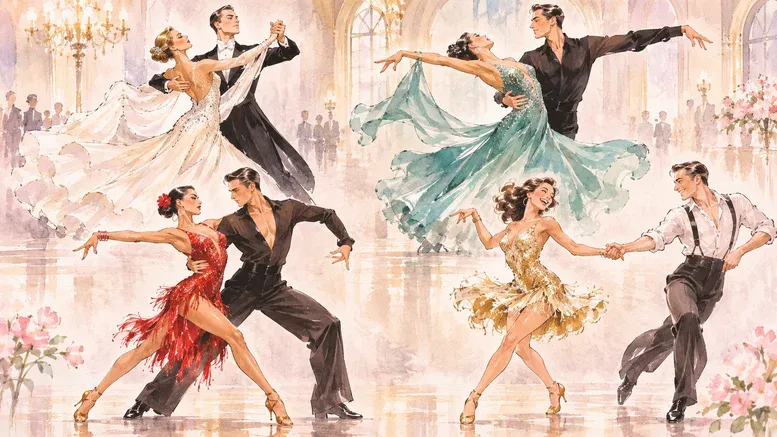
The main types of ballroom dances are grouped into four style families: International Standard, International Latin, American Smooth and American Rhythm. Each family is a short list of dances, and the lists overlap. Waltz, tango and foxtrot sit in two families, cha cha and rumba in two others, so one dance name can describe two different classes.
Types of ballroom dances by style family
The NDCA championship dance lists (July 2026 edition, section IX.A) give you a reference for the four families. These are competition lists, not a requirement that every class cover every dance. International Standard is also called International Ballroom.
| Family | Dances in the championship list | Names shared with the paired family |
|---|---|---|
| International Standard | Waltz, Tango, Viennese Waltz, Slow Foxtrot, Quickstep | Waltz, Tango, Viennese Waltz, Foxtrot with Smooth |
| American Smooth | Waltz, Tango, Foxtrot, Viennese Waltz | All four with Standard |
| International Latin | Cha Cha, Samba, Rumba, Paso Doble, Jive | Cha Cha and Rumba with Rhythm |
| American Rhythm | Cha Cha, Rumba, Swing, Bolero, Mambo | Cha Cha and Rumba with Latin |
The World DanceSport Federation lists the same five Standard and five Latin dances.
American Smooth and International Standard
These are the two families built on the waltz, tango, foxtrot and Viennese waltz. Standard also includes quickstep, which isn’t in the Smooth championship list.
Even the music tempos differ. The NDCA tempo table lists Viennese waltz at 58 measures per minute in International Standard and 53 in American Smooth; foxtrot is 28 in Standard and 30 in Smooth. These are competition tempos, not instructions for how fast your beginner class must dance.
A visible difference is the hold. Standard partners maintain their hold throughout the dance. The NDCA’s American Smooth reference lists positions beyond closed, such as open facing and promenade.
The NDCA tempo table also lists Peabody under American Smooth, though the championship list above has four Smooth dances. The four-dance list is not the full set of approved American-style dances.
American Rhythm and International Latin
Cha cha and rumba appear in both families. In the championship lists above, Rhythm adds swing, bolero and mambo; Latin adds samba, paso doble and jive.
Samba and paso doble are not exclusive to the International list: the NDCA also names them among its additional American-style dances and lists both in its tempo table under a nightclub heading. So a social class or competition listing can carry “samba” without being International Latin.
Swing is the name the NDCA uses in its Rhythm list; its syllabus appendix calls it East Coast Swing. West Coast Swing is listed separately among the additional American-style dances.
Why some dance names appear twice
The lists count a dance within each style, so American rumba and International rumba occupy separate entries. Add the table rows and you get 19 entries: 5 + 4 + 5 + 5. Count the names once, treating Slow Foxtrot and Foxtrot as the same name for this calculation, and you get 13. Six names repeat across the table. Neither count is a universal total of all ballroom dances.
A schedule entry that says only “Rumba, Level 1” doesn’t tell you which rumba. Look for International Latin or American Rhythm in the course description. If neither appears, ask which style the class teaches.
Social dances outside these lists
The four championship lists leave out dances you may want to learn socially. The NDCA also permits additional American-style events, naming bachata, cumbia, hustle, jitterbug, Lindy Hop, merengue, nightclub two-step, polka, salsa, West Coast Swing, and Argentine tango, Argentine vals and milonga.
Argentine tango is listed separately from the ballroom tango in the families above. If Argentine tango is what you want to learn, a class labeled simply “tango” needs clarification.
Before you try any of these at a party, the etiquette guide covers what to expect at a first social.
Questions to ask before choosing a class
Before booking, ask:
- Is this International or American style? If the studio uses a syllabus, ask which one.
- Which dances does the course cover, and in what order? A “Smooth” series should name its dances. So should a “Latin” series.
- Is the class aimed at social dancing, competition, or both?
- What does a booking include? The lesson cost guide helps you compare group classes, private lessons and packages.
Once you’ve picked a class, the first-lesson clothing checklist helps you prepare.
Found an error or something unclear? Send us the detail to check. Corrections are described in our editorial policy.