Context
Famous Ballroom Dancers: Champions and Key Figures
10 famous ballroom dancers and partnerships: WDC world champions, plus the film, social-dance and teaching pioneers, and how to check titles.
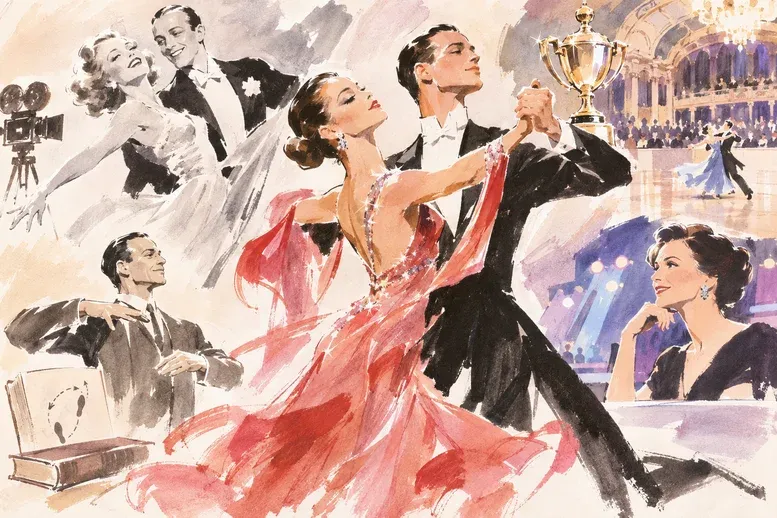
Ask ten people to name famous ballroom dancers and you’ll get two different lists. One person says Fred Astaire and Ginger Rogers or Vernon and Irene Castle; another says Donnie Burns and Gaynor Fairweather, 14-time World Professional Latin champions, or Arūnas Bižokas and Katusha Demidova, who won 10 World Professional Ballroom titles. Both answers are right, which is why “greatest of all time” rankings fall apart: they score Hollywood legends on the same sheet as judged DanceSport champions.
What “famous” means in ballroom dancing
Ballroom fame runs on two tracks, and mixing them up hides what someone actually accomplished.
The first is competitive DanceSport. Partnerships are judged head-to-head in specific divisions, most commonly International Standard (Ballroom) and International Latin, at sanctioned events like the World Dance Council (WDC) World Championships and the Blackpool Dance Festival. Fame on this track is measured in titles, years undefeated, and influence on how a style is danced. If you are still sorting out the difference between Standard, Latin, Smooth, and Rhythm, our guide to ballroom dance styles maps out the four families.
The second is film, social dance, and teaching. Figures on this side rarely held world championship trophies, yet they shaped what the public thought ballroom dancing looked like and how beginners learned it: exhibition teams, Hollywood musical stars, a studio franchiser, a textbook author.
Television pros from Dancing with the Stars and Strictly Come Dancing sit in the overlap. Shirley Ballas, for one, won Professional Latin at Blackpool in 1995 and 1996 before becoming head judge on Strictly in 2017. TV fame shifts every season, so this guide sticks to historical champions and foundational figures whose record is settled.
Quick reference: 10 famous ballroom dancers and partnerships
| Dancer or partnership | Track | Peak period | Verified milestone |
|---|---|---|---|
| Bill & Bobbie Irvine | Competitive (Ballroom & Latin) | 1960–1968 | 13 world titles across Professional Modern, Latin, and combined events; MBE (1967) |
| Donnie Burns & Gaynor Fairweather | Competitive (Latin) | 1984–1998 | 14 WDC World Professional Latin titles (1984–1996, 1998) |
| Marcus & Karen Hilton | Competitive (Ballroom) | 1990–1998 | 9 consecutive WDC World Professional Ballroom titles |
| Bryan Watson & Carmen Vincelj | Competitive (Latin) | 1999–2007 | 9 consecutive WDC World Professional Latin titles |
| Arūnas Bižokas & Katusha Demidova | Competitive (Ballroom) | 2009–2018 | 10 consecutive WDC World Professional Ballroom titles (representing the USA) |
| Riccardo Cocchi & Yulia Zagoruychenko | Competitive (Latin) | 2010–2019 | 10 consecutive WDC World Professional Latin titles (representing the USA) |
| Vernon & Irene Castle | Social & exhibition | 1910s | Popularized ragtime-era social dances (foxtrot, hesitation waltz, tango) in the US |
| Fred Astaire & Ginger Rogers | Film | 1930s | Made 10 musicals together, nine of them for RKO from 1933 to 1939; kept dancers in full view on camera |
| Arthur Murray | Teaching & business | 1920s–1950s | Built a US studio franchise chain and hosted The Arthur Murray Party on TV (1950–1960) |
| Alex Moore | Standardization | 1930s onward | Wrote a 1936 ballroom technique book that underpins ISTD International Standard; devised the chart format for describing figures |
Competitive DanceSport champions
In competitive ballroom, the partnership is the unit. You will almost always see these names written as pairs, because the titles belong to the couple in a specific division and year. All six partnerships below are WDC world champions.
Bill and Bobbie Irvine
Before top professionals split cleanly into Ballroom or Latin, Bill and Bobbie Irvine won across both. Between 1960 and 1968, the British couple won 13 world titles in Professional Modern (Ballroom), Professional Latin, and combined events. In 1967 they received the first MBE awarded for ballroom dancing.
Donnie Burns and Gaynor Fairweather
If one partnership is called the benchmark of competitive Latin, it is usually Donnie Burns and Gaynor Fairweather. Burns is Scottish and Fairweather English, and together they won 14 WDC World Professional Latin Championships: 13 straight from 1984 through 1996, then another in 1998. Both were appointed MBE in 1991, and Burns became President of the WDC in 2005.
Marcus and Karen Hilton
While Burns and Fairweather dominated Latin in the 1990s, Marcus and Karen Hilton held the Professional Ballroom (Standard) side. They won nine consecutive WDC World Professional Ballroom titles from 1990 through 1998. Their first came with a British Open win at Blackpool the same year.
Bryan Watson and Carmen Vincelj
Representing Germany, Bryan Watson and Carmen Vincelj took over the Professional Latin title right after Burns and Fairweather’s last win. They won nine consecutive WDC World Professional Latin Championships from 1999 through 2007 and retired from competition that year.
Arūnas Bižokas and Katusha Demidova
World-level International Standard is often assumed to be a European story. Arūnas Bižokas and Katusha Demidova, representing the United States, won 10 consecutive WDC World Professional Ballroom Championships from 2009 through 2018.
Riccardo Cocchi and Yulia Zagoruychenko
Over almost the same decade, Riccardo Cocchi and Yulia Zagoruychenko matched that run on the Latin side, also for the United States. They began dancing together in 2007, won 10 consecutive WDC World Professional Latin Championships from 2010 through 2019, and announced their retirement after the tenth, in Miami.
Film, social-dance and teaching pioneers
None of the people below won a WDC world title, yet a beginner walking into a US dance studio today is stepping into the world they built.
Vernon and Irene Castle
In the 1910s, husband-and-wife exhibition dancers Vernon and Irene Castle made ragtime-era social dances respectable for mainstream American audiences. They popularized the foxtrot, hesitation waltz, one-step, and tango, and opened Castle House in New York, where they taught society the latest steps by day.
Fred Astaire and Ginger Rogers
Fred Astaire and Ginger Rogers made nine musicals together at RKO between 1933 and 1939, including Top Hat, Swing Time, and The Story of Vernon and Irene Castle, plus a tenth, The Barkleys of Broadway, in 1949. Astaire insisted on filming a routine in as few shots as possible, with the dancers kept in full view, so audiences could see the partnering rather than a series of cutaways.
Arthur Murray
Arthur Murray learned at the Castles’ school and briefly taught there before turning social ballroom into a national business. He started with mail-order footprint diagrams, built a franchised chain of studios across the United States, and backed The Arthur Murray Party on television, which ran from 1950 to 1960. Even if you never set foot in one of his studios, the neighborhood franchise studio is a business model he helped put on the map.
Alex Moore
You won’t see Alex Moore in old Hollywood clips, but his work sits behind International Standard teaching. The English teacher and author, later Chairman and then President of the Imperial Society of Teachers of Dancing (ISTD), published his ballroom technique book in 1936, and it became the basis of the ISTD’s International Standard reference. He also devised the chart format used to describe dance figures. If you want to decode the vocabulary that came out of that era, our ballroom dance terms glossary covers the basics in plain English.
How to verify ballroom titles and results yourself
Bio blurbs on studio websites love vague labels like “former world champion” or “international finalist.” Before taking a title at face value, check four details: the sanctioning organization, the division (Ballroom/Standard, Latin, Smooth, or Rhythm), the exact year, and the partner’s name.
Three primary sources cover most of what you will need:
- World Dance Council (WDC): The WDC website publishes a Former WDC World Champions registry of Professional Ballroom and Professional Latin winners.
- World DanceSport Federation (WDSF): For WDSF amateur and professional division events, the WDSF competition results can be filtered by competition type and age group.
- National Dance Council of America (NDCA): For US competition categories and rules, the NDCA Rule Book sets the rules for competing in the US.
If you’d rather skip the history and get ready for your first lesson, the beginner guides on Ballroom Dance Planet are the place to start.
Found an error or something unclear? Send us the detail to check. Corrections are described in our editorial policy.